
When we think about renovation, retrofit, or facility upgrade projects, we need to remember that they all start with one important thing: getting the existing conditions right.
Every successful project needs this to go well.
Unfortunately, a lot of teams still use drawings, incomplete records, or measurements they took by hand when they are planning what to do.
This can cause problems like design conflicts, surprises when they get to the site, delays in the project, and extra work that could have been avoided.
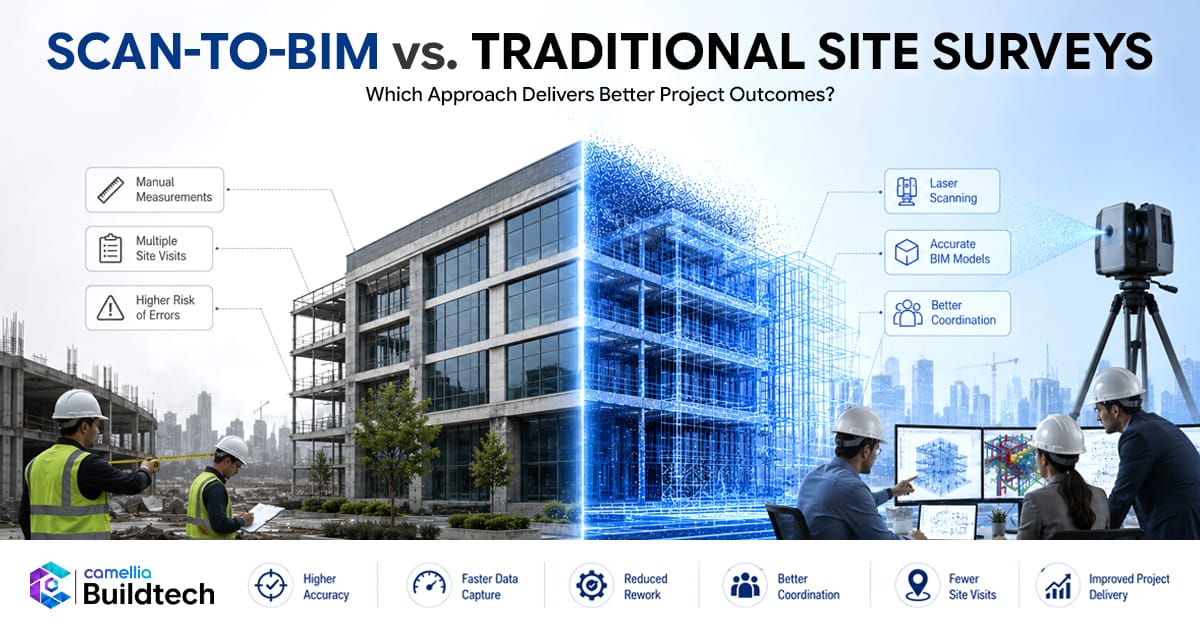
As projects get more complicated, more people like architects, engineers, contractors, and facility owners are using Scan-to-BIM because it is a more efficient way to do things than traditional site surveys.
The Challenge with Traditional Site Surveys
Traditional surveys usually mean people have to take measurements by hand, take pictures, make sketches, and write down notes when they visit a site. This is what people have been doing for a time. Sometimes it does not work very well for big and complicated projects, like the construction of buildings or something. Traditional surveys can be a problem when the project is really complex.
Common issues include:
- Missing or inaccurate measurements
- Multiple site visits to verify dimensions
- Time-consuming documentation processes
- Limited visibility of complex building conditions
- Increased risk of design and coordination errors
For projects, these limitations are something you can deal with. On the other hand, renovation projects and retrofit projects are different because even small mistakes with renovation projects and retrofit projects can cause big problems, with construction and cost a lot more money than planned for renovation projects and retrofit projects.
What Is Scan-to-BIM?
Scan-to-BIM uses laser scanning technology to get a lot of accurate information from a building that already exists.
The information that is collected is called point cloud data. This point cloud data is then changed into a BIM model.
This BIM model has information about the architecture, the structure, and the mechanical, electrical, and plumbing systems of the building.
Project teams that use Scan-to-BIM do not have to guess about the building. They get to see an accurate digital picture of the building before they start designing. This digital picture is a Scan-to-BIM model.
The Scan-to-BIM model is based on the point cloud data that was collected from the existing building.
So project teams can make decisions based on the Scan-to-BIM model.
Scan-to-BIM vs. Traditional Surveys
1. Accuracy That Reduces Risk
Traditional surveys are based on people taking measurements and watching what is happening in the field.
Scan-to-BIM technology gets the shape of the building exactly right, giving us good information for design, coordination, and planning the construction of the building with Scan-to-BIM.
Benefit: Fewer surprises during construction and reduced risk of costly field modifications.
2. Faster Data Collection
Documenting a place like a large facility by hand can take a lot of time, usually several days. You often have to go to the facility again to get all the information you need.
Using a laser scanner is a lot faster. It can capture all the details about the building in a much shorter time. Laser scanning gets all the information about the facility quickly.
Benefit: Faster project startup and reduced disruption to occupied facilities.
3. Improved BIM Coordination
Inaccurate information about the state of a building often causes problems between the architectural, structural, and mechanical systems.
The people working on the project have to deal with these issues.
With Scan-to-BIM, the people on the project team use an accurate model of the building.
This model helps the team work together better during the design process.
Benefit: Fewer clashes, fewer RFIs, and less rework during construction.
4. Better Decision-Making
A Building Information Modeling model gives all the people involved in a project an idea of what things are like before any work starts.
People like architects, engineers, contractors, and owners can see what might be difficult about the Building Information Modeling model, and make good choices because they have a Building Information Modeling model to look at.
Benefit: Improved planning and reduced project uncertainty.
5. Long-Term Value Beyond Design
BIM models are really useful even after the construction work is finished, which is not the case with survey drawings.
BIM models remain valuable long after the construction work is complete.
They can support:
- Facility management
- Asset tracking
- Space planning
- Future renovations
- Operations and maintenance
- Digital twin initiatives
Benefit: A single source of accurate building information throughout the asset lifecycle.
Ideal Applications for Scan-to-BIM
Scan-to-BIM is very useful for projects where getting things right is very important, including:
- Building renovations and retrofits
- Healthcare facilities
- Educational campuses
- Commercial developments
- Industrial and manufacturing facilities
- Historic preservation projects
- Airports and transportation infrastructure
- Facility management programs
Why More AEC Firms Are Making the Switch
Today, projects need to be done accurately and on time. They also need to be well organized.
We still do site surveys for smaller projects. For big projects, we use something called Scan-to-BIM. This gives us the precision and speed we need for design and construction.
When we start a project, we make sure we have all the information about the site. This helps us avoid mistakes, work together better, and finish the project quickly.
How Camellia Buildtech Can Help
At Camellia Buildtech, we do Scan-to-BIM services. We take point cloud data. Turn it into accurate models of buildings. These models show what the architecture, structure, and systems of the building will be.
Our team works with architects, engineers, contractors, and people who own buildings. We help them make plans that are reliable. This helps them plan better, work together, and get results for their projects.