
Mechanical, electrical, and Plumbing projects have started seeing changes due to digital engineering. It eliminates traditional approaches to project development, introduces connected processes that increase collaboration, minimize errors, and accelerate the construction process. For MEP contractors and engineers, digital transformation means the change in workflow rather than the introduction of software products for building infrastructure.
What is Digital Engineering in MEP?
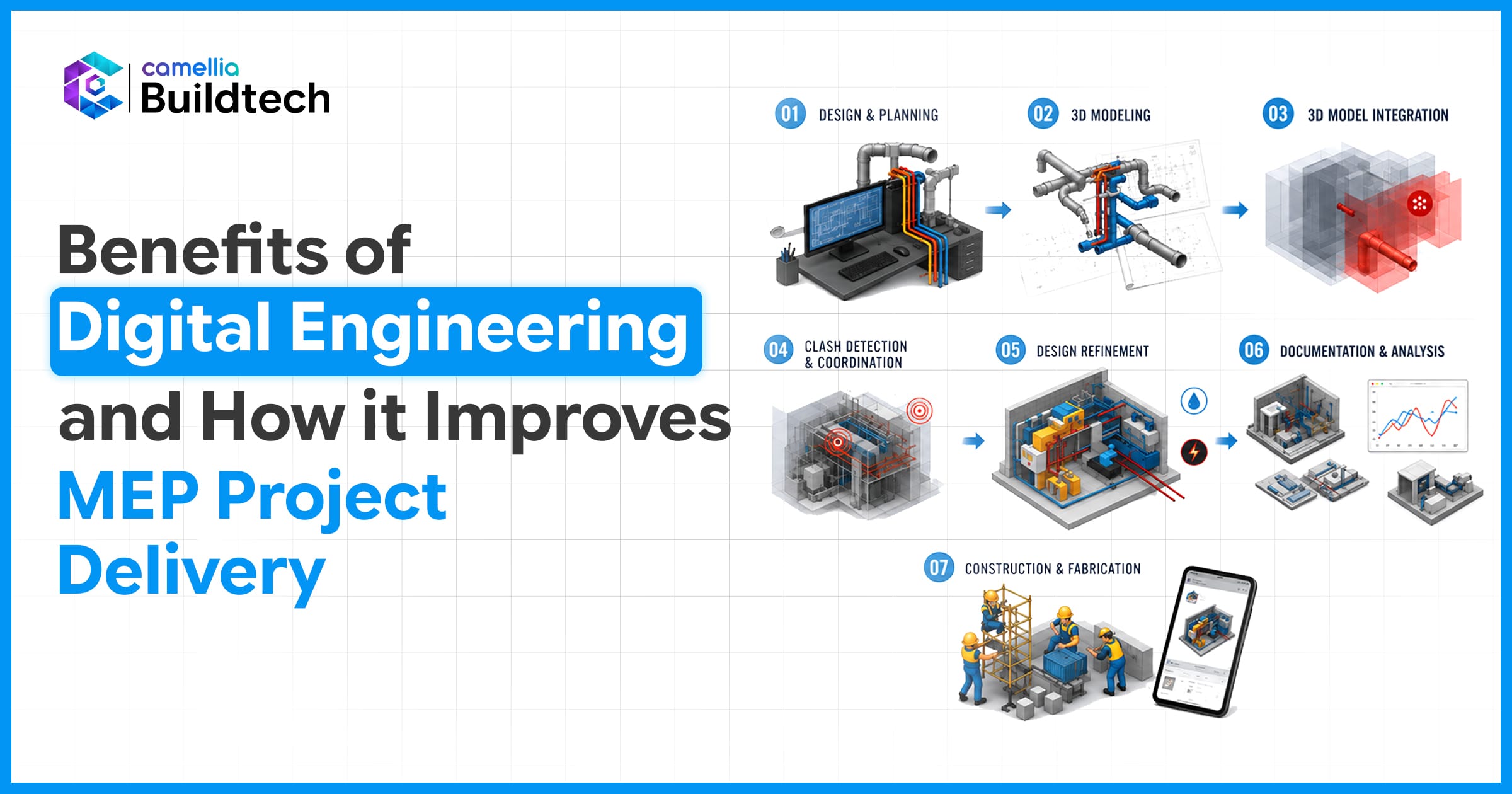
Digital engineering of MEP projects relies on such technologies as Building Information Modeling, 3D coordination, data analytics, and others. Thus, it implies a transition from a 2D MEPwing-based approach to design and coordination of building systems to one shared 3D model that contains information on all building elements, including HVAC ducts, electrical wiring, and plumbing pipes.
The implementation of the mentioned technology leads to the creation of a central repository of data that allows the uniting of efforts of architects, structural engineers, and MEP specialists without miscommunications and errors typical of traditional workflows.
How Digital Engineering Improves MEP Project Delivery
1. Early Clash Detection and Reduced Rework
One of the benefits of digital engineering is that it can find problems between different building systems before construction starts. In a 3D model, you can see if a heating and cooling duct is going through a beam or if a plumbing pipe is crossing an electrical wire, and you can fix it before you even start building.
When Mechanical, Electrical, and Plumbing systems are coordinated in a Building Information Modeling environment, problems are fixed at the planning stage, which prevents changes and delays. Research shows that Building Information Modeling has an effect on performance indicators for Mechanical, Electrical, and Plumbing contractors, including how much money they make, how long it takes to finish a project, how efficient they are on site, and how much rework they have to do. For companies that use coordinated Building Information Modeling workflows, the cost of rework can go down from 8-10% of the project cost to under 2-3%. This is a deal.
2. Improved Collaboration Across Disciplines
Digital engineering dissolves the silo effect between architects, structural engineers, and MEP designers. Instead of working on separate drawings and coordinating manually, all disciplines work in a unified digital environment.
The current Mechanical, Electrical, and Plumbing (MEP) team uses tools such as Revit and Navisworks to create digital models of the systems and work together with the team members in a timely manner. It means that when the architect moves the wall, or the structural engineer modifies the size of the beam, the MEP team will know about that and modify its plan.
3. Faster and More Accurate Documentation
Digital engineering has made a lot of the paperwork that was created by people before automation. It means that when something is changed in the 3D model, the plans, sections, and schedules are automatically updated. This ensures the construction documentation is accurate and up-to-date.
It is extremely important because, as Camellia Buildtech states, a good design can fail due to a mess of the initial CAD data or difficulty in understanding the shop drawings. The elimination of the “garbage in, garbage out” cycle is what makes the construction of the last mile to succeed. Camellia Buildtech assists AEC companies in creating accurate digital construction documentation by bringing architecture, structure, and MEPF disciplines together.
4. Prefabrication and Off-Site Construction
Digital models help not only coordinate but also fabricate things. With 3D models, Mechanical, Electrical, and Plumbing components can be manufactured off-site and assembled on-site, reducing labor costs and installation time.
Mechanical, Electrical, and Plumbing contractors using Building Information Modeling are increasingly using it for prefabrication, which allows for installation, less material waste, and consistent quality. Studies show that when BIM is combined with off-site prefabrication and better sequencing, construction time can be saved by 20–40%.
5. Better Cost Control and Material Optimization
Digital engineering provides accurate quantity takeoffs directly from the model. This enables better cost estimation and material procurement, reducing waste and avoiding costly overruns.
Integrated design can save up to 50% in material costs by moving from individual MEP supports to a coordinated multi-trade version. By designing Mechanical, Electrical, and Plumbing supports from a coordinated model, teams can reduce the number of parts they need, which cuts down on material costs and installation time.
6. Data for Facility Management and Lifecycle Value
The benefits of digital engineering extend beyond construction. The BIM model created during design and construction can be handed over to the building owner as a digital asset, supporting facility management, maintenance, and future renovations.
When models are handed to facilities management, owners get a digital asset that reduces operating costs and improves maintenance response. For complex MEP systems, this lifecycle value is a major component of BIM’s return on investment.
A Real-World Example: Fastening Systems
A good example of digital engineering in action comes from the MEP sector itself. Sikla, a manufacturer of fastening solutions, found that its products were often overlooked in the planning process. Less space was being given to increasingly complex MEP technology, making early integration critical.
By adopting Building Information Modeling and developing its plug-ins for Autodesk Revit, Sikla was able to integrate its products into the planning process. This allowed the company to work on projects, provide better cost estimates, and improve collaboration with customers. As one manager noted, the company can now “provide much better cost estimates that match the models, have an improved visualization of projects before construction starts, collaborate more easily with customers, and uncover problems at any time”.
The Bottom Line
Digital engineering is not just a fad, but rather becoming the norm in Mechanical, Electrical, and Plumbing project delivery. When companies embrace digital engineering, the advantages are obvious: more accuracy, speed, cost reduction, and improved building design. For those who do not the risk of falling is growing.
As Camellia Buildtech emphasizes, the key is integrating Architecture, Structure, and MEPF disciplines under a unified framework to eliminate coordination silos and optimize the project lifecycle—from pre-construction to facility management. When done right, digital engineering turns Mechanical, electrical, and Plumbing design from a source of risk into a part of making a project successful.
Frequently Asked Questions (FAQs)
1. What is the main benefit of digital engineering for MEP projects?
The main benefit is improved coordination through clash detection, which significantly reduces costly rework and project delays. BIM can reduce rework costs from 8-10% to under 2-3% of project cost.
2. How does BIM help with the prefabrication of MEP systems?
The geometry and data provided by Building Information Modeling LOD 400-500 allow fabricators to make pipe spools, ductwork, and support brackets off-site and save time in installation. Time savings in terms of fabrication and installation can reach up to 3x.
3. Does digital engineering save money on MEP projects?
Yes. Studies show that Building Information Modeling projects report savings on labor, collaboration, and materials. Integrated design can save up to 50% in material costs.
4. What software is commonly used for MEP?
The Autodesk Revit software is where Mechanical, Electrical, and Plumbing modeling is performed, followed by clash detection and coordination in Navisworks. Additional software like Dynamo is used for automation.
5. Can digital engineering help with building maintenance?
Yes. The BIM model created during design and construction can be handed over to facilities management, providing a digital asset that reduces operating costs and improves maintenance response. This is the foundation for digital twins of MEP systems.
6. What career opportunities does digital engineering create for MEP engineers?
Digital engineering gives way to job positions like Mechanical, Electrical, and Plumbing Building Information Modeling Modeler, Building Information Modeling Coordinator, Building Information Modeling Engineer, and Building Information Modeling Manager. Mechanical, Electrical, and Plumbing engineers with Building Information Modeling qualifications tend to have salaries increase of 10-30% per year.